Vibe-Blindness: Why Your Fastest Reps Are Losing Your Biggest Deals

Everyone has a vibe now. Which means nobody has an edge.
Your reps are faster than ever. And yet 70% of them missed quota last year. Not because they didn't work hard enough. Because they worked hard in the wrong direction.
The time AI saved wasn't reinvested into selling. It was reinvested into the volume knob.
Welcome to the era of Vibe-Blindness. And it's exactly why your most efficient reps are losing your biggest deals.
What Vibe Selling Actually Is
"Vibe" started with developers. Andrej Karpathy coined Vibe Coding in early 2025: stop writing code, start directing AI. The idea spread fast. Too fast.
Within months it had jumped to sales floors with a new name: Vibe Selling. Same premise. Stop writing. Start directing. Let AI handle emails, summaries, CRM and research.
The efficiency gains are real. Search interest in Vibe Coding grew 6,700% in the first half of 2025 alone. For the grunt work, it delivers.
Nobody serious is arguing against that.
But somewhere along the way, directing the AI became a substitute for understanding the buyer. And that's where the deals started dying.
The Race to the Middle
The problem isn't that your reps are using AI wrong. The problem is that AI is working exactly as designed, and that's the trap.
AI models are trained on averages. They generate the most likely successful email. The most likely effective follow-up. The most likely winning subject line. But when 81% of reps are using the same AI tools, the output stops being an edge. It becomes noise with better grammar.
The vibe has been commoditised.
67% of B2B buyers now prefer a rep-free experience. Not because they hate salespeople. Because they've learned to pattern-match AI-generated outreach and filter it out before it lands.
But here's the stat that should keep every enterprise sales leader up at night: 68% of B2B buyers already have a front-runner vendor in mind before the first meeting. And that front-runner wins the deal 80% of the time.
Read that again. The deal is decided before the meeting. Before the pitch. Before the perfectly vibed follow-up sequence.
Vibe Selling optimises for the outreach. The game is won before the outreach.
Vibe-Blindness
There's a rep on your team right now who is doing everything right.
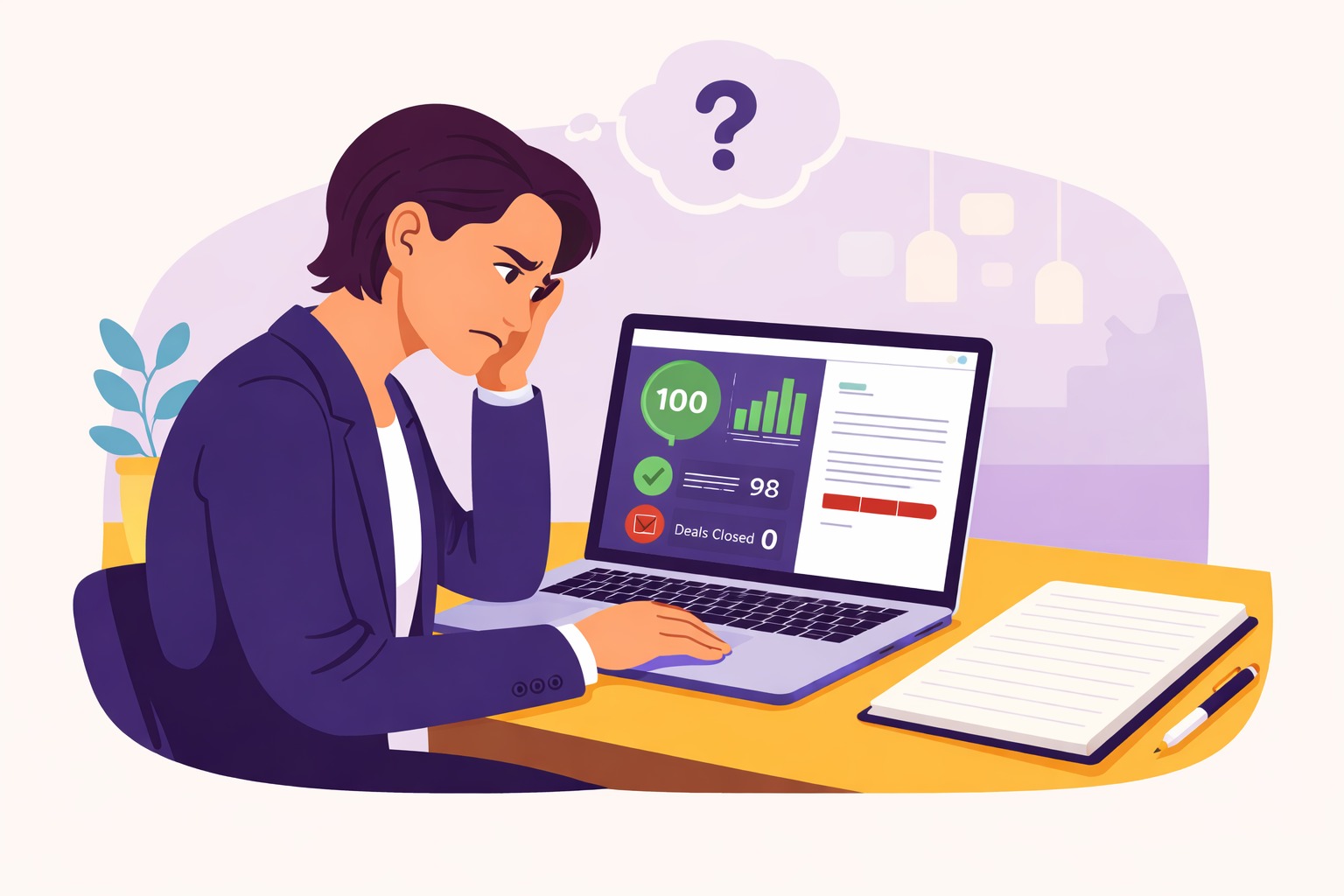
Their activity score is green. Their outreach volume is up. Their AI tools are humming. Every email looks polished. Every follow-up lands on time. Their manager sees momentum. The CRM shows progress.
And they're losing the deal.
Not because they're lazy. Not because they're incompetent. Because they're efficiently wrong. Moving faster than ever, in the wrong direction, with a dashboard that will never tell them so.
It's not visible on any dashboard. It doesn't show up in activity metrics. It only shows up in the final 10% of the funnel, when the deal that looked green turns dark.
72% of sellers already feel overwhelmed by the number of skills their role demands. 50% are overwhelmed by the technology they're required to use daily.
These aren't underperformers. These are people who found a tool that made them look like they were performing, and leaned into it.
Vibe Selling didn't create lazy reps. It created the perfect conditions for invisible failure.
79% of sales teams grew revenue last year. Yet up to 70% of individual reps missed quota. The org looks healthy. The individuals are bleeding out. That's not a performance problem. That's a visibility problem.
And you can't fix what you can't see.
The Boardroom Gap
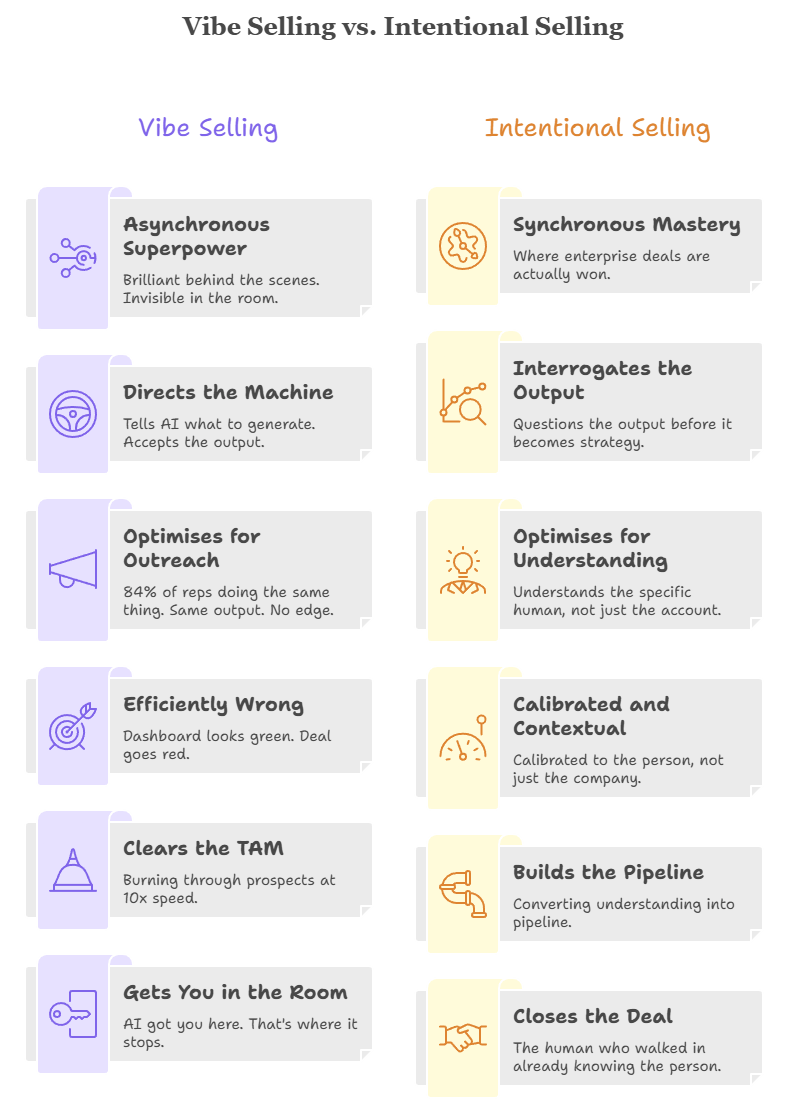
Vibe Selling has a superpower. And a blind spot. And the line between them is razor thin.
The superpower: everything that happens before the meeting. The emails. The research. The summaries. The CRM. Asynchronous work — the work that happens when the buyer isn't watching — is where Vibe Selling genuinely delivers. It clears the deck. It creates space. It makes your rep look prepared before they've even opened a browser.
The blind spot: everything that happens in the meeting.
Enterprise deals are won in synchronous moments. The live call. The negotiation. The moment a CFO leans back and asks the question your rep didn't see coming. And no AI tool in the world can vibe its way through them.
Because the CFO isn't evaluating your rep's email cadence. They're evaluating whether this person understands my world. Whether they've done the work to know what keeps me up at night. Whether I can trust them with something that matters.
That's not a vibe. That's understanding. And understanding can't be generated. It has to be earned.
Reps who bring specific, contextual business insights to conversations see a 50% average increase in win rates. Not general insights. Not AI-summarised talking points. Specific, contextualised knowledge about the person across the table.
And when reps engage decision makers correctly — not just reaching them but actually understanding them — they are 233% more likely to close the deal.
The Calibration Gate
The answer isn't to stop using Vibe Selling. The answer is to stop letting it be the last step.
Sellers who partner with AI are 3.7x more likely to meet quota. Not sellers who use AI instead of thinking. Sellers who use AI and then think. That distinction is everything.
Here's what that looks like in practice:
- The AI drafts the outreach. The rep asks: who is this person, how do they make decisions, what do they actually care about right now?
- The AI summarises the call. The rep asks: what did they not say? What's the subtext? What's the real objection underneath the polite one?
- The AI researches the account. The rep asks: what does this mean for the specific human I'm meeting on Thursday?
Efficiency is the floor. Accuracy is the ceiling.
That's not a vibe. That's intelligence. And that's how you become the front-runner before the meeting even starts.
The Vibe Can't Walk Into the Room. You Can.

Every advantage in enterprise sales gets commoditised eventually. Price. Product. Speed. Outreach volume. And now, the vibe.
The teams that win in 2026 won't be the ones with the most sophisticated AI stack. They'll be the ones who figured out that AI is the setup, not the close.
The close still belongs to the human who walked into the room already knowing the person across the table. Not just their title. Not just their company's tech stack. But what keeps them up at night, and what would make them trust you with the answer.
The sellers who win aren't the ones with the best tools. They're the ones who made understanding the buyer their highest priority.
That's not something you can generate. It's something you have to earn, one calibrated conversation at a time.
Vibe Selling gave your reps the time to do that work.
The question is whether they're using it.
Content that moves buyers.
Not just fills a calendar.
If this is how you think about content, we should talk. Buyer-first strategy for B2B SaaS companies.
Book a free intro call